
Typographic palette designed for vibrant code and user interfaces.
What it costs
- Free tier
- Yes
Free and open-source variable font, available via Google Fonts and GitHub; no paid tier.
Auto-checked on 8 August 2026Source
About Recursive Sans & Mono
What Is Recursive Sans & Mono?
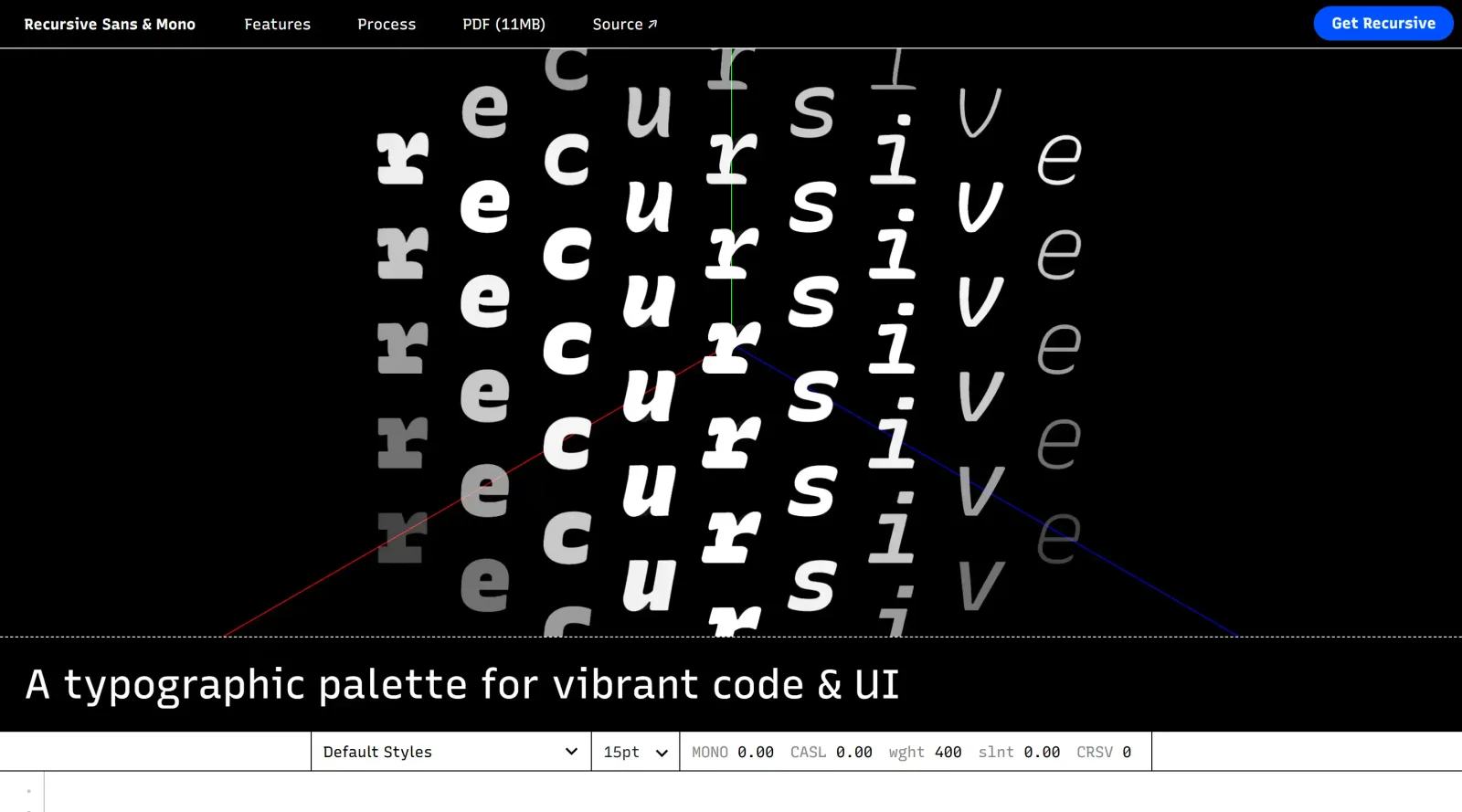
Recursive Sans & Mono is a free variable font family in the typography category, designed as a typographic palette for code and user interfaces. It functions as a five-axis variable font, allowing adjustments across multiple stylistic dimensions from a single font file. Recursive Sans & Mono supports both proportional Sans and fixed-width Mono subfamilies, drawing inspiration from single-stroke casual signpainting styles. Developers and designers integrate it into UI layouts and code editors where consistent metrics enable smooth transitions without layout shifts.
What Recursive Sans & Mono Does
- Provides five variable axes: Monospace (MONO) from proportional Sans (0) to fixed-width Mono (1), Casual (CASL) from linear to brush-like forms, Weight (wght) from 300 to 1000, Slant (slnt) from 0 to -15 degrees, and Cursive (CRSV) with options for roman, auto, or always cursive letterforms.
- Maintains identical glyph widths, kerning, and letterforms across all 32 instances in its superplexed Sans subfamily for layout stability during style changes.
- Enables fluid transitions between proportional and monospaced widths, including semi-proportional or semi-monospaced custom instances.
- Supports shared metrics in Sans and Mono subfamilies, preventing layout breaks in UI elements like menus and buttons during animations or interactions.
- Includes a modified Google Fonts Latin Expert character set, covering Latin-based languages, currencies, symbols, fractions, and arrows.
- Offers separate control over slant angle and cursive forms independently of weight or casual variations.
How Recursive Sans & Mono Can Be Used
- In code editors, set the Monospace axis to 1 for fixed-width glyphs suited to programming, tabular data, or disambiguating characters like in passwords.
- For UI design, apply proportional Sans at Monospace 0 with varying weights and slants to create hover effects or button states without reflowing text layouts.
- Combine Casual axis with Slant and Cursive for expressive headings or interactive elements that shift from linear to brushy styles on user engagement.
- Develop animated typographic transitions in web applications, leveraging consistent metrics to animate from light upright roman to bold slanted cursive forms.
- Pair Sans and Mono in the same font file for hybrid interfaces, such as dashboards displaying both readable body text and code snippets seamlessly.
Who Is Recursive Sans & Mono For?
Recursive Sans & Mono serves UI designers, front-end developers, and type enthusiasts working on digital interfaces and code displays. It fits projects requiring a single font file with versatile control for both proportional UI text and monospaced code, particularly where layout consistency during style variations is essential. Those handling Latin-script content in web apps, code editors, or interactive prototypes benefit from its axes for weight, slant, casualness, monospace, and cursive adjustments. Experience levels range from intermediate users familiar with variable fonts to advanced practitioners exploring superplexed metrics. Visit Recursive Sans & Mono
Featured Tools
Sponsored
Artlist
Royalty-free music, SFX, 8K footage, templates, LUTs and 100+ AI models on a single subscription for video creators.

Icons8
Large icon packs featuring over 10,000 icons for consistent design themes.

Vidu
AI video generator with text, image and reference-to-video modes, producing 3–16 second clips at up to 1080p with characters that stay consistent across shots.
Your tool here
The tools above are our own picks until the slots sell.
Spotlight
SponsoredRotates daily
Kittl
AI-first design platform with image, vector, and video generation, plus templates, mockups, and print-ready exports.
Tools we recommend
Editorially chosen. Some links above are affiliate links — if you sign up we may earn a commission, at no extra cost to you.
More Typography Tools

FontsBy
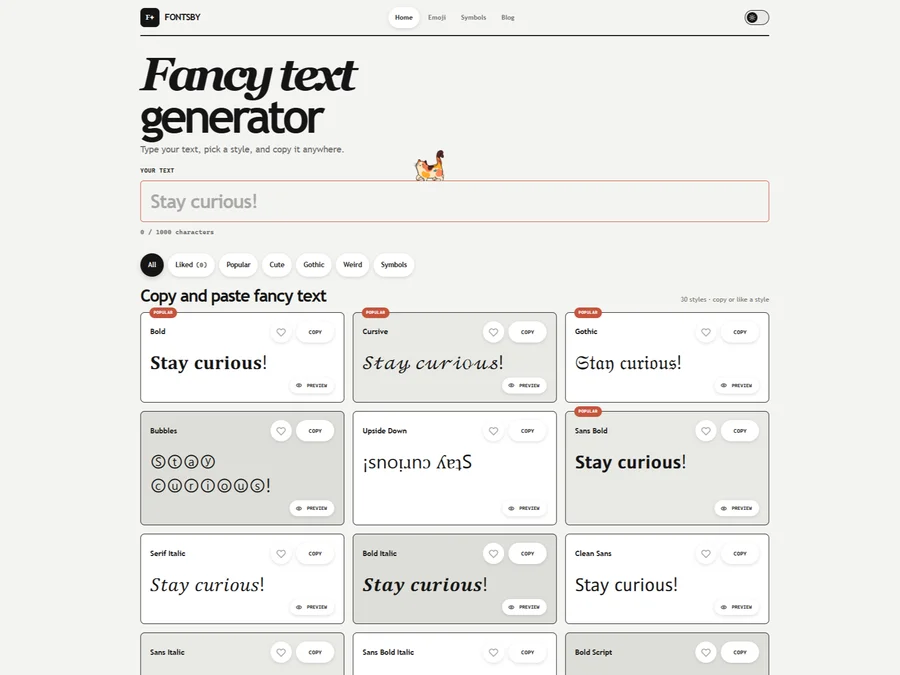
Fancy text generator for Instagram, Twitter, TikTok and Discord. Copy and paste bold, cursive and stylish Unicode fonts, symbols and emoji instantly for bios, usernames, names and social media posts.


205TF
French type foundry showcasing work from independent designers.


All Free Fonts
A selection of beautiful, free fonts curated for quality.


atipo
Digital foundry and design studio specializing in typefaces.


Beautiful Web Type
Guide to the best open-source typefaces.


Birdfont
Browser-based font editor for creating vector graphics.
Explore Other Categories
Discover more design resources
New to Design?
Explore our comprehensive design glossary to master essential terminology from A/B Testing to Wireframes.
Browse GlossaryLooking for something specific?
Search through our entire collection of design tools and resources